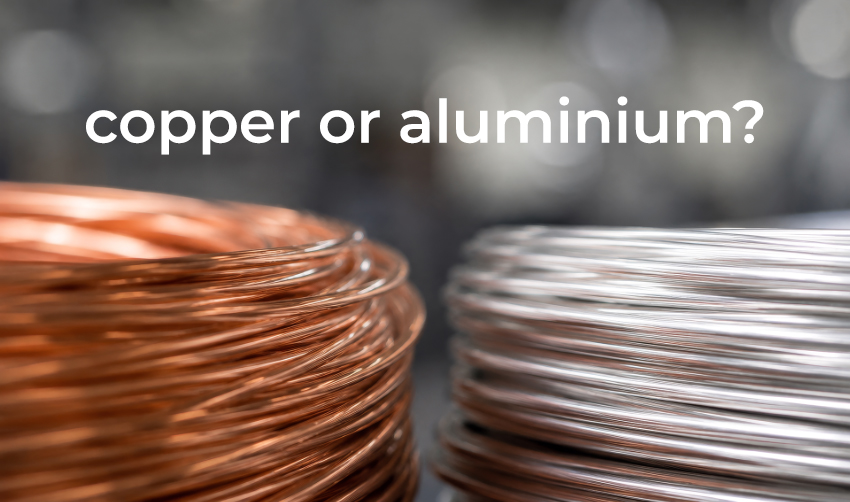
Copper remains the most efficient choice for electric motor windings.
Aluminium can reduce weight and material cost, especially when the price of copper has a large impact on the project.
The conductivity of aluminium is about 61% compared to copper, so a larger conductor section is needed.
The correct choice depends on the required efficiency, size, work cycle, costs and application targets of the motor.
Copper or aluminium: a technical choice that nowadays also affects costs
The choice between copper and aluminium in asynchronous and synchronous windings is not just about electrical performance. For the customer, it means assessing material cost, motor efficiency, weight, size and long-term reliability.
In a context in which copper has a high cost, aluminium may become an alternative worth considering in some applications. For us at Came, however, the assessment must always start from the motor design and application.
Copper offers the greatest efficiency, compactness and reliability
Copper remains the reference material when the customer needs high performance. Its higher conductivity can reduce electrical losses, keep sections smaller and make motors more compact.
Copper is particularly suitable when the following are required:
-
- maximum efficiency;
- continuous use;
- high loads;
- compact motors;
- long service life;
- simpler and more robust connections.
For the customer, copper may have a higher initial cost, but it can offer benefits throughout the motor life cycle when efficiency and operational continuity are a priority.
Aluminium can reduce weight and material cost
Aluminium can be attractive when the project requires lower weight or limited material cost. In fact, it has a much lower density than copper, and can make the component lighter.
Aluminium can be considered when the customer is looking for:
-
- lower material cost;
- lower weight;
- economic optimisation on high volumes;
- intermittent applications;
- low-power motors;
- projects in which size is not critical.
In these cases, aluminium is not an inferior choice at all, it is a different choice, to be designed correctly.
The limitation of aluminium is its lower conductivity
The main limitation of aluminium is its lower electrical conductivity compared to copper. An aluminium conductor must have a larger section for the same performance.
This affects motor size, slot fill factor, connections, thermal management and the winding process. For the customer, it means comparing material savings with the entire project.
When to choose copper or aluminium
Aluminium can be chosen when the economic benefit or weight reduction is more important than maximum absolute efficiency: it is especially suitable for applications with a strong focus on cost, intermittent use or limited power, or for projects in which the conductor section can be increased.
Copper, on the other hand, remains the most suitable choice when the customer wants the greatest efficiency, compactness and long-term reliability. It is the most suitable solution for motors intended to work continuously with high loads or in applications in which service life is a core requirement.
Technical assessment reduces risks before industrialisation
Changing the winding material can change the motor behaviour, and can affect the wire section, slot fill factor, insulation, heat dissipation and connection quality.
Therefore, the choice must be made before industrialisation, not when the project is already defined. During our technical support and feasibility work, we at Came help the customer assess the material that is most consistent with the expected result.
Copper for maximum performance, aluminium for lightness and limited costs
There is no absolute choice between copper and aluminium. Copper is the most suitable solution when the customer is looking for efficiency, compactness, durability and reliability. Aluminium can be considered when the project requires lower weight, limited material cost and greater dimensioning flexibility.
The best choice is the result of balancing required performance, material cost, application constraints and customer targets.