

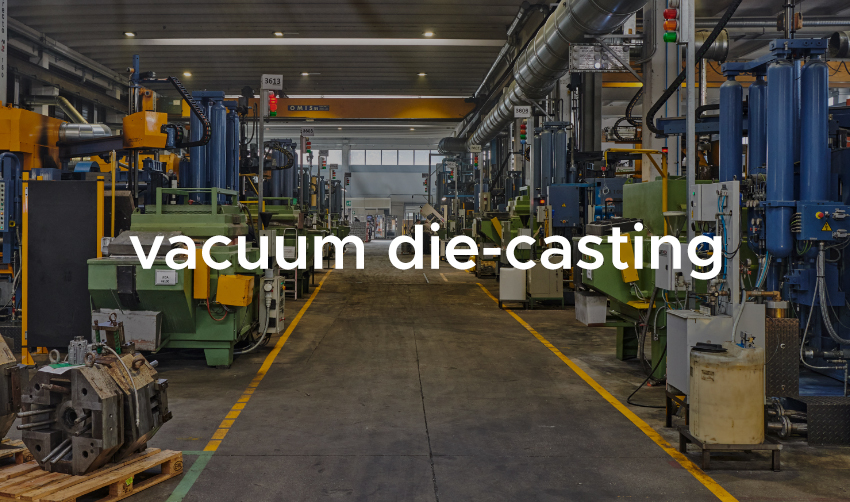
Vacuum die-casting improves aluminium casting quality by reducing porosity and increasing process control.
Press, mould and vacuum generation system must be considered as a single integrated process.
For the customer, this means obtaining more compact, more reliable components that are safer in subsequent machining processes.
At Came, we use vacuum die-casting when the component must have greater internal quality, complex geometries, and more controlled mechanical performance.
A process choice to improve casting quality
In some cases, customers rely on us at Came for components that must meet high quality and reliability standards. In such cases, the choice of vacuum die-casting is guided by the customer’s technical procurement specifications, which impose strict limits on internal defects and casting performance.
The vacuum system extracts air and gas from the mould cavity just before the metal is injected. This reduces one of the main risks in aluminium casting production: internal porosity.
The value of vacuum in reducing porosity
In die-casting, air and gas can become trapped in the casting while filling the mould, which leads to porosity, blowholes and internal discontinuities that compromise component quality, especially when the workpiece must undergo subsequent machining or ensure mechanical performance.
That is why we at Came consider vacuum die-casting as a concrete tool to improve casting compactness and ensure a more stable end result.
Press, mould and vacuum must work together
To work correctly, the vacuum method must be considered right from the mould design stage. The press, mould and vacuum cannot be considered as separate elements, because the resulting quality depends on their integration.
At Came, we analyse the process as a whole, considering component geometry, mould filling, air evacuation and metal behaviour during injection.
Greater control in complex geometries
Vacuum die-casting becomes particularly useful when the component features complex geometries, varying thicknesses or areas that are hard to fill. In these cases, better air evacuation helps the metal flow into the mould cavity in a more controlled manner.
For the customer, this means reducing the risk of defects, improving the internal casting quality, and obtaining a component that is more in line with the technical requirements.
A benefit in subsequent machining processes as well
The value of vacuum die-casting is not limited to the die forming stage. A more compact casting with lower porosity can also offer greater reliability in subsequent machining processes, when any internal defects can emerge and compromise the component.
That is why we at Came consider casting quality to be part of a broader process: not only to produce the part, but to help the customer obtain a more reliable and machinable component.
Understanding the process before producing the component
From the customer’s perspective, value does not just stem from using vacuum in die-casting, but from knowing when this solution is really useful, how it should be integrated into the mould, and what benefits it can bring to the final component.
At Came, we bring together aluminium die-casting expertise, production process know-how, and attention to casting quality to help the customer make safer decisions.
This is what vacuum die-casting means: transforming a technical choice into a process that is more controlled, more reliable and more in line with the required component performance.

Davide Urbani
Area Technical Manager of the Die-Casting Div.
consulting@came-italy.com
+39 0444 488282


